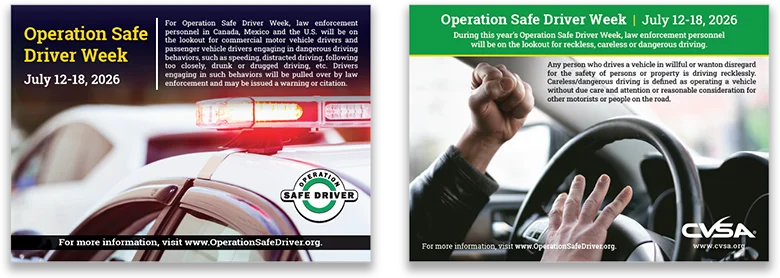

The Commercial Vehicle Safety Alliance (CVSA) has scheduled this year’s Operation Safe Driver Week for July 12-18, 2026.
Operation Safe Driver Week is “a safe-driving enforcement and outreach initiative aimed at improving driving behaviors through educational and traffic-enforcement strategies and driver interactions with law enforcement.” (Source)
Operation Safe Driver Week 2026 Focus
This year, the CVSA is focusing on reckless, careless or dangerous driving. These behaviors are defined by the CVSA: “Any person who drives a vehicle in willful or wanton disregard for the safety of persons or property is driving recklessly. Careless/dangerous driving is defined as operating a vehicle without due care and attention or reasonable consideration for other motorists or people on the road.” (Source)
Throughout Operation Safe Driver Week, law enforcement officers across the United States, Canada, and Mexico will be closely monitoring drivers engaging in any problematic or risky behaviors. Those caught engaging in unsafe behaviors will be pulled over and issued a warning or citation.
How to Prevent Dangerous Driving Habits
According to 2025 data provided by the U.S. National Highway Traffic Safety Administration (NHTSA), 36,640 people were killed in traffic crashes. In order to prevent dangerous driving habits, it’s important to eliminate any visual and physical distractions. NHTSA safety resources report that reducing distracted driving is one of the most effective ways to prevent crashes.
Eliminate the “Four D’s” of Hazardous Driving
Dangerous driving is defined by the Four Ds: distracted, drunk/drugged driving, and drowsy.
- Distracted: Put your phone on Do Not Disturb mode before starting your vehicle. If you can, map out your GPS route and adjust your climate controls and mirrors before taking off.
- Drunk: Never operate a vehicle after consuming alcohol. Even small amounts can impair your judgment, reaction time, and your ability to drive safely.
- Drugged: Never drive under the influence of recreational drugs or prescription medications that can cause drowsiness, slowed reaction times, or impaired judgment. Always read medication warnings before getting behind the wheel.
- Drowsy: Avoid driving if you are feeling tired or sleepy. A good practice is to take a minimum 15-minute break every two hours during longer trips. If you’re an overnight hauler, try to get the recommended 7-9 hours of quality sleep.
Practice Speed and Time Management
Impatience and time pressures are two of the top causes for aggressive driving habits such as speeding and tailgating. To avoid these, try:
- Adding an extra 10 to 15 minutes of time to your commute. This will help you naturally reduce the urge to speed, if you happen to fall behind schedule.
- Using cruise control on open highways to keep your speed steady and within safe, lawful limits.
- Forcing yourself to make a complete stop at every red light and stop sign to make sure your vehicle comes to a complete stop before proceeding.
Adopt Smarter Defensive Driving Habits
Safe driving starts with keeping a safe distance. Next time you hit the road, start forming these three safety habits:
- Maintain a 3-4 second following distance behind the vehicle in front of you. Double this distance to six seconds during conditions like rain, snow, or nighttime driving.
- Scan Intersections: Do not rely solely on traffic lights. Continuously scan left, right, as well as ahead to read traffic patterns and identify any erratic driving behaviors.
- Communicate Early: Always signal lane changes and turns well in advance to alert surrounding motorists.
Drive Smart, Drive Safe
At Coopersburg & Liberty Kenworth, we support the CVSA’s mission to create safer roads for everyone. Join us in making road safety a priority by reflecting on your own driving habits. By staying alert, avoiding distractions, and following traffic laws, you can help make a real difference. Let’s work together to keep our roads safe.
Read more CVSA content here.
For resources on technology that will help you drive less distractedly, read our truck tech blogs.